A divided Supreme Court on Wednesday appeared skeptical of President Donald Trump’s authority to unilaterally impose sweeping tariffs under a federal emergency powers law, as the justices weighed one of the defining economic policies of his second term and tested the limits of presidential power.
During nearly three hours of oral arguments, several justices expressed concern that Trump’s reliance on the International Emergency Economic Powers Act (IEEPA) to levy tariffs on nearly every U.S. trading partner lacked clear congressional authorization. The administration argues that the law’s provision allowing the president to “regulate importation” gives him broad authority to impose tariffs during national emergencies.
But multiple justices, including Chief Justice John Roberts and Justice Amy Coney Barrett, questioned whether Congress ever intended to delegate such sweeping power.
“The statute doesn’t use the word ‘tariffs,’” Roberts said. “While these duties deal with foreign powers, the vehicle is imposition of taxes on Americans, and that has always been a core power of Congress.”
Justices Weigh Separation of Powers
Justice Neil Gorsuch raised concerns about separation of powers, asking whether the administration’s interpretation of IEEPA would allow Congress to “abdicate all responsibility to regulate foreign commerce.”
“Once Congress delegates its authority to the president, it’s difficult to reclaim,” Gorsuch warned, calling the administration’s view “a one-way ratchet toward the gradual but continual accretion of power in the executive branch.”
Justice Brett Kavanaugh appeared more sympathetic to the administration, noting that IEEPA allows for a range of emergency tools, including trade embargoes, and questioned why tariffs, a “less extreme measure,” would not fall under that authority.
“You’re forcing the president to respond to an emergency and taking away one of his tools,” Kavanaugh said.
The Stakes for Trump’s Tariff Policy
The case marks the first time the Supreme Court has examined the legal foundation of Trump’s global tariffs, which he has described as essential to his “America First” economic strategy. Three lower courts have struck down most of the duties, ruling that IEEPA does not grant the president power to impose such broad import taxes.
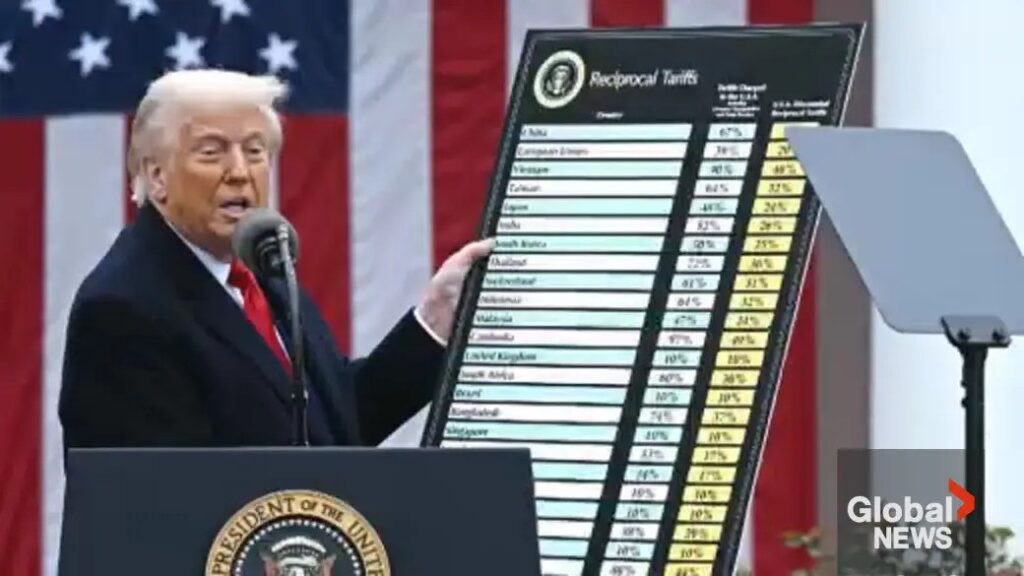
At issue are two rounds of tariffs issued this year through executive orders that declared trade imbalances and cross-border drug trafficking as national emergencies. The orders imposed a 10% baseline tariff on nearly all U.S. trading partners and additional duties on China, Canada and Mexico in response to what Trump described as their failure to stop the flow of fentanyl and other illegal drugs.
In court filings, Solicitor General D. John Sauer argued that IEEPA continues a long tradition of giving presidents flexibility in responding to global crises. Striking down the tariffs, he wrote, would have “catastrophic consequences for national security, foreign policy and the economy.”
“To the president, these cases present a stark choice: with tariffs, we are a rich nation; without tariffs, we are a poor nation,” Sauer said.
Businesses Argue Tariffs Are Illegal Taxes
Lawyer Neal Katyal, representing small businesses challenging the tariffs, argued that the Constitution reserves the power to impose taxes to Congress.
“Tariffs are taxes,” Katyal told the justices. “If Congress delegates this authority, it’s a one-way ratchet. We will never get this power back.”
Katyal said if the court sides with the administration, future presidents could impose unlimited duties “on any product, from any country, at any rate, for any length of time.”
Barrett was the only justice to raise the question of potential refunds to U.S. importers if the tariffs are struck down. Katyal said refunds would be handled through established trade law but acknowledged that the process would be “difficult.”
Testing Presidential Power
The case comes amid broader questions about Trump’s use of executive authority, from firing independent officials to withholding congressionally approved aid and expanding his control over federal agencies.
The court’s decision could redefine the balance of power between Congress and the White House on economic and foreign policy.
In recent years, the Supreme Court has invoked the “major questions doctrine” to limit executive power in high-impact policy areas, striking down former President Joe Biden’s student loan forgiveness plan and eviction moratorium. The justices may now apply the same reasoning to Trump’s tariffs, though the administration contends that national security and foreign policy fall outside that doctrine’s reach.
“Judges lack the institutional competence to determine when foreign affairs pose an unusual and extraordinary threat,” Sauer argued. “That is a task for the political branches.”
The Supreme Court fast-tracked the case after agreeing in September to hear it. A decision could come within weeks and will determine whether Trump can continue using emergency powers to unilaterally shape U.S. trade policy.
Trump, who called the case “one of the most important in the history of our country,” did not attend the arguments but said afterward that a loss would be “devastating for our country.”