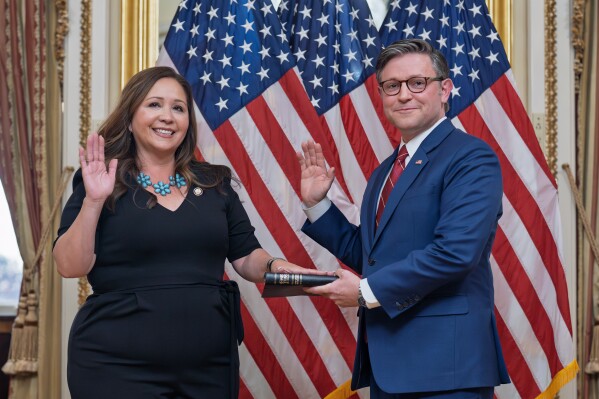
Seven weeks after winning a special election, Adelita Grijalva was sworn in on Wednesday.
Grijalva, on Sept. 23, overwhelmingly won the seat once occupied by her late father Rep. Raul Grijalva, a progressive. The House went out of session after her victory and House Speaker Johnson said he would not swear her in until the government shutdown ended.
Democrats lambasted Johnson over the delay and the Arizona attorney general, a Democrat, sent a letter threatening to sue over the matter.
“Failing to seat Ms. Grijalva immediately or to otherwise provide a reasonable explanation as to when she will be seated will prompt legal action,” Arizona Attorney General Kris Mayes wrote.
Democrats were vocal, to the extent of showing up at Johnson’s office, about what was perceived as an obstruction to getting another Democrat in the House and narrowing the Republicans’ meager majority.
Johnson maintains that his reason for delaying the swearing ceremony was that he wanted to ensure Grijalva had a full chamber session including “pomp and circumstance.
After she was sworn in, Grijalva made a speech in which is called herself the “proud granddaughter of a bracero” and a U.S. congressman. She also hinted at Johnson delaying her swearing in and how it has affected her constituents.
“It has been 50 days since the people of Arizona’s 7th Congressional District elected me to represent them, 50 days that over 800,000 Arizonans have been left without access to the basic services that every constituent deserves,” Grijalva said.
“This is an abuse of power. One individual should not be able to unilaterally obstruct the swearing in of a duly elected member of Congress for political reasons,” she continued.
Democrats had claimed that Johnson was trying to prevent enough votes for the release of files regarding the Jeffrey Epstein investigation. Even Trump’s MAGA base has called for more clarity concerning the matter.
Grijalva, in her first act as a congressperson, is the 218th signature that a bipartisan discharge petition needed to force a vote on the release of the files.
That action will require the House to vote in the coming weeks on forcing the Justice Department to release all files tied to its investigation into Epstein. But the measure is unlikely to clear the Senate or win President Donald Trump’s signature, as he has personally urged Republicans to block the effort.