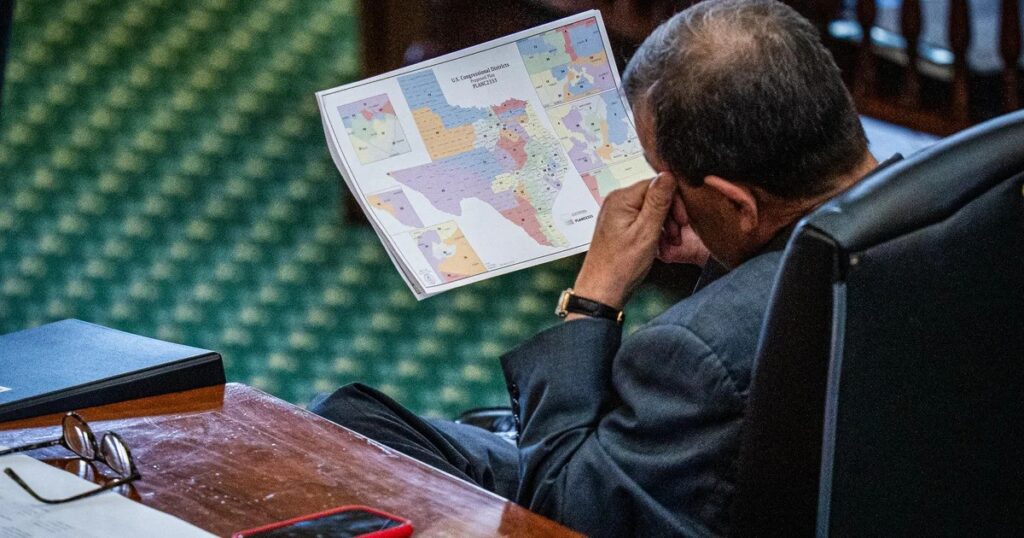
Texas Republicans have had their hopes dashed as a three-member panel of judges in El Paso blocked the state’s new gerrymandered voting maps.
In a 2-1 decision, the three-judge panel said the map, created earlier this year to boost Republican representation, violated both the U.S. Constitution and the federal Voting Rights Act by diluting the political power of Black and Hispanic voters.
Key Findings and Legal Basis
Judge Jeffrey V. Brown, appointed by Donald Trump, wrote the majority opinion, concluding that the map’s designers prioritized racial considerations over purely partisan ones, a distinction that triggered the legal prohibition.
“To be sure, politics played a role in drawing the 2025 Map. But it was much more than just politics. Substantial evidence shows that Texas racially gerrymandered the 2025 Map,” the ruling states.
The judges indicated they believe the challengers are likely to prevail when the case goes to trial. Judge Jeffrey V. Brown was joined in the majority by an appointee of Democratic President Barack Obama, while a judge appointed by Republican President Ronald Reagan dissented.
The majority wrote that without an injunction blocking the new map, minority voters would be forced to live under congressional districts shaped by “likely unconstitutional racial classifications for at least two years.”
The appeals panel found that one of the main factors driving Gov. Greg Abbott and GOP lawmakers to redraw the map was a July letter from the head of the Justice Department’s Civil Rights Division. In that letter, Harmeet Dhillon, the assistant attorney general overseeing the division, directed Texas to dismantle four districts the department said violated the Voting Rights Act.
Dhillon pointed to a ruling last year from the conservative federal appeals court for Texas, Louisiana and Mississippi, which held that the Voting Rights Act does not allow different minority groups to combine their populations to show that a map dilutes their voting power. Instead, the court said each group must be evaluated on its own.
Dhillon’s letter focused on four so-called “coalition” districts, one around Dallas and three in the Houston area, where no single racial or ethnic group holds a majority, but minority voters collectively outnumber white voters. She argued those districts were “vestiges of an unconstitutional racially based gerrymandering past” and should be eliminated.
The judges deemed that conclusion “legally incorrect” but noted that Texas lawmakers still embraced the racial aims described in the letter.
“The redistricting bill’s sponsors made numerous statements suggesting that they had intentionally manipulated the districts’ lines to create more majority-Hispanic and majority-Black districts,” the ruling said.
Implications for 2026
Because the court granted a preliminary injunction, Texas must use the congressional map from 2021 for the upcoming midterm election. This significantly alters the contours of several districts that had been engineered to add up to five new Republican-leaning seats.
Republicans hold 25 of Texas’ 38 congressional seats, and the new map would have reduced the number of majority-minority districts while converting coalition districts into more safely Republican ones. The court found that change was not merely politically motivated but racially discriminatory.
Paxton Vows Appeal
Voting rights advocates hailed the decision.
“Today’s decision is a critical victory for voting rights and a powerful rebuke of Texas’s brazen attempt to dilute the political power of Latino and Black voters,” said Abha Khanna of Elias Law Group, which represented minority-voter plaintiffs
Texas Attorney General Ken Paxton announced the state will appeal the ruling to the U.S. Supreme Court, calling the decision “a major setback for Texas voters.”
If the state’s appeal fails, the ruling could force major revisions in how redistricting is conducted in Texas and influence national policy on how race and politics interact in the drawing of electoral maps.