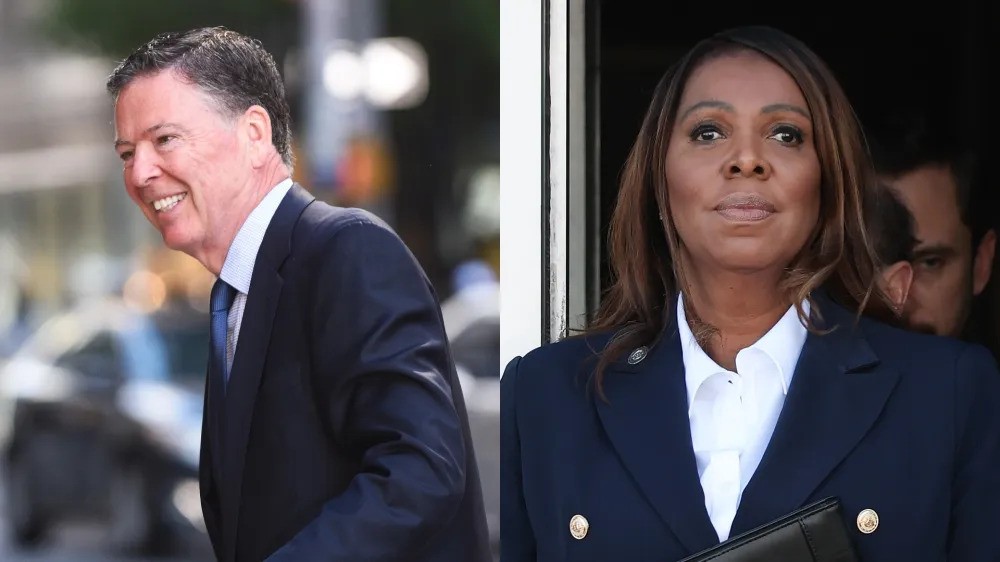
A federal judge on Monday dismissed the criminal indictments against former FBI Director James Comey and New York Attorney General Letitia James, ruling that President Donald Trump’s appointment of an interim U.S. attorney in Virginia was unlawful.
U.S. District Judge Cameron McGowan Currie found that Lindsey Halligan, a former White House adviser whom Trump installed to lead the Eastern District of Virginia, was improperly appointed and therefore lacked the authority to bring the cases.
“The Attorney General’s attempt to install Ms. Halligan as Interim U.S. Attorney for the Eastern District of Virginia was invalid,” Currie wrote. She added that “all actions flowing from Ms. Halligan’s defective appointment,” including the indictments against Comey and James, “were unlawful exercises of executive power and are hereby set aside.”
The judge dismissed the cases without prejudice, allowing prosecutors to potentially refile the charges. But Currie noted that the statute of limitations appears to have run out for some of the allegations against Comey, making future prosecution unlikely.
The Justice Department did not immediately respond to a request for comment.
Responses From Comey and James
Letitia James called the ruling “a victory” and thanked supporters nationwide.
“I am heartened by today’s victory and grateful for the prayers and support I have received from around the country,” she said. “I remain fearless in the face of these baseless charges as I continue fighting for New Yorkers every single day.”
Comey addressed the dismissal in an Instagram video, calling the case “a prosecution based on malevolence and incompetence” and saying it reflected the state of the Justice Department under Trump.
He praised career officials who refused to participate in what he described as a politicized prosecution.
“It cost some of them their jobs, which is painful, but it preserved their integrity, which is beyond price,” he said.
Comey warned that Trump could target him again but said he is not intimidated.
“I’m innocent. I am not afraid. And I believe in an independent federal judiciary … that protects us from a would-be tyrant,” he said.
The White House defended the original indictments, with spokesperson Abigail Jackson telling CNN that the facts “have not changed” and “this will not be the final word on this matter.”
Why the Appointment Was Invalid
Halligan was appointed after the administration removed the previous interim U.S. attorney, Erik Siebert, amid pressure from Trump to pursue criminal charges against his political adversaries.
Defense attorneys argued that Halligan’s appointment violated federal law because the 120-day limit for an interim U.S. attorney had expired months before she took office. Currie agreed, writing that the clock began on January 21, 2025, with Siebert’s appointment and expired on May 21.
“When that clock expired … so too did the Attorney General’s appointment authority,” she wrote, concluding that Attorney General Pam Bondi’s move to install Halligan in September was “invalid” and that Halligan had “unlawfully” served in the role since then.
Currie said allowing the government’s interpretation would effectively permit an administration “to evade the Senate confirmation process indefinitely by stacking successive 120-day appointments.”
She also rejected the notion that Bondi could retroactively legitimize Halligan’s actions.
“That cannot be the law,” she wrote, warning that such a system would allow the government to “send any private citizen off the street … into the grand jury room to secure an indictment” with only after-the-fact approval.
Broader Context
Currie pointed to the recent dismissal of the federal classified documents case against Trump, in which a judge ruled that Special Counsel Jack Smith had been unlawfully appointed, in determining that dismissing the Comey and James indictments was the appropriate remedy.
Halligan brought the Comey indictment before a grand jury just days after taking office, and prosecutors had defended her authority by arguing that the 120-day requirement served merely as an administrative check-in. Currie rejected that argument, saying the law’s limits are explicit.
Attorneys for the plaintiffs described Monday’s ruling as a significant rebuke of the administration’s handling of politically charged prosecutions.