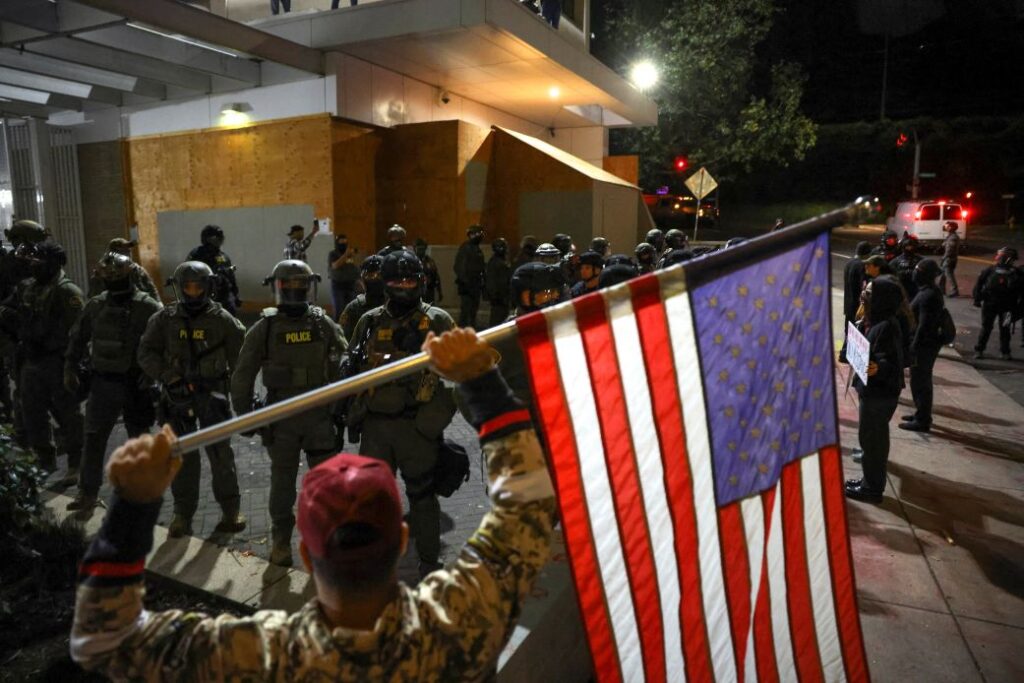
A federal judge on Sunday temporarily blocked President Donald Trump’s administration from deploying National Guard troops from Texas and California to Portland, Oregon, in a ruling that further limits the president’s ability to send military forces into Democratic-led cities.
U.S. District Judge Karin Immergut, who was appointed by Trump, issued the temporary restraining order after previously denying the administration’s request to use Oregon’s own National Guard troops in the city. The order will remain in effect until at least Oct. 19.
The ruling came shortly after the Pentagon confirmed that 200 members of the California National Guard had been reassigned to Portland to “support U.S. Immigration and Customs Enforcement and other federal personnel performing official duties.”
California and Oregon both sought emergency court orders to block the deployment, arguing the move violated state sovereignty. Immergut agreed, saying there was no evidence that recent protests in Portland justified federalized National Guard troops.
During an emergency hearing Sunday, Immergut pressed government attorneys on whether the plan to send troops from other states was an attempt to circumvent her earlier decision denying Oregon’s deployment. In that earlier ruling, she said using military forces without a state’s consent risked undermining state authority and inflaming tensions.
Trump has authorized the deployment of National Guard units to several cities, including Chicago, Illinois, as part of his effort to combat what he calls “out-of-control crime” amid ongoing protests over immigration enforcement.
White House Deputy Chief of Staff Stephen Miller denounced the ruling on X, calling it “one of the most egregious and thunderous violations of constitutional order we have ever seen” and claiming it was part of an effort “to nullify the 2024 election by fiat.”
Miller later told reporters that Trump was considering “a very broad range of authorities” to deploy federal assets despite the court order but declined to provide details.
White House Press Secretary Karoline Leavitt said the administration believes Trump acted within his legal rights.
“Judge Immergut’s decision is untethered in reality and in the law,” Leavitt told reporters. “We’re very confident in the president’s legal authority to do this, and we’re very confident we will win on the merits.”
The Trump administration is expected to appeal the ruling.
Meanwhile, Illinois officials filed a lawsuit Monday to block a similar deployment of National Guard troops to Chicago.
“The American people, regardless of where they reside, should not live under the threat of occupation by the United States military, particularly because their state leadership has fallen out of a president’s favor,” Illinois Attorney General Kwame Raoul said.
Trump told reporters in the Oval Office he was considering invoking the Insurrection Act if courts continued blocking his attempts to send troops into U.S. cities.
“We have an Insurrection Act for a reason,” Trump said. “If people were being killed and courts were holding us up or governors or mayors were holding us up, sure, I would do that.”
Illinois Gov. J.B. Pritzker said late Sunday that Trump was. “ordering 400 members of the Texas National Guard for deployments to Illinois, Oregon and other locations within the United States.”
In a statement, Pritzker called the move “Trump’s invasion” and said there was “no reason to send troops into any state without the knowledge, consent or cooperation of local officials.”
He told CNN that such authorizations would “incite protests” and accused the administration of creating a “war zone” to justify its actions.
Pritzker also urged Texas Gov. Greg Abbott to “immediately withdraw any support for this decision.” Abbott responded that he had “fully authorized” the deployment of Texas National Guard members “to ensure safety for federal officials.”
“You can either fully enforce protection for federal employees or get out of the way and let Texas Guard do it,” Abbott wrote on X.
Protests in both Portland and Chicago have intensified in recent weeks amid heightened immigration enforcement. On Saturday, immigration authorities said they opened fire on an armed woman after she and others allegedly rammed their cars into law enforcement vehicles during a demonstration. The woman’s condition was unclear, though officials said she drove herself to a hospital.
Trump has sought to use National Guard troops in several cities, including Washington, D.C., and Los Angeles, to bolster immigration enforcement and address urban crime.
The National Guard, a reserve component of the Army and Air Force, can be activated by state governors or the president. It is often deployed for disaster relief but can also support military or federal missions.
In September, a federal judge in California ruled Trump’s prior deployment of the National Guard to Los Angeles violated federal law restricting domestic military use. The administration is appealing that decision.