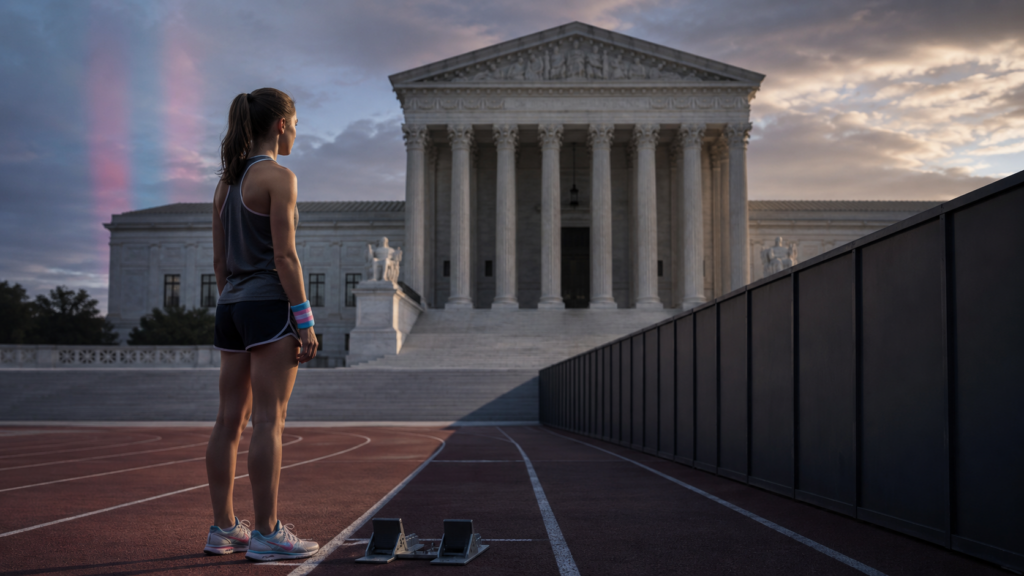
The Supreme Court on Tuesday allowed state bans on transgender athletes in girls’ and women’s sports to stand.
In a 6-3 ruling, the highest court ruled against two trans students, Becky Pepper-Jackson and Lindsay Hecox, who sued over such laws in West Virginia and Idaho, respectively.
Justice Brett Kavanaugh wrote the majority opinion that the state laws violate neither the 14th Amendment guaranteeing equal protection nor Title IX that bans sex-based discrimination in education.
“They [the states] may determine eligibility for women’s and girls’ sports based on biological sex. The Constitution and Title IX do not require an overhaul of women’s and girls’ sports throughout America,” Kavanaugh wrote. He also noted that he respects their desire to compete and that they should not be ostracized.
Justice Sonia Sotomayor dissented, joined by Justices Elena Kagan and Ketanji Brown Jackson, writing that the majority showed “great sympathy” for the cisgender girls and women who play sports, a concern she said she shared. But Sotomayor said the ruling imposed a hardship on those the majority disfavored without giving them the full and fair chance to make their constitutional arguments in court.
Although the plaintiffs in the case argued laws in two specific states, there are 25 other states with similar laws that are likely to be affected by Tuesday’s ruling.
Trump, who just lost three cases with the SCOTUS, took to Truth Social to celebrate what he called a victory.
“BIG WIN: The United States Supreme Court just RULED AGAINST MEN PLAYING IN WOMEN’S SPORTS,” he posted. The Trump administration has long supported the bans.
On a more local level, West Virginia Gov. Patrick Morrisey praised the ruling, saying the state had defended what he called “a simple principle most Americans instinctively understand,” that women’s sports should give women and girls a fair chance to compete and succeed.
Activists and advocates for the LGBTQ community criticized the ruling, saying that it is doing the opposite of what it claims: guaranteeing fairness.
“By allowing sweeping restrictions on a very small number of transgender students who simply wanted to participate in sports alongside their peers, the ruling creates an unnecessarily unfair playing field,” Sarah Kate Ellis, president of GLAAD, an advocacy group, said in a statement.
One of the lawyers who represented the plaintiffs, Joshua Block of the ACLU, called the ruling “heartbreaking” for his clients and those like his clients.
Pepper-Jackson, 16, is a high school sophomore who has taken puberty blockers and estrogen and whose sports of interest are cross-country, shot put, and discus. Hecox, 25, is in college and has had testosterone suppression and estrogen treatments. Hecox tried out for track and cross country teams in college without success and has also participated in running and club soccer.
The SCOTUS began hearing oral arguments in January and at the time, Justice Gorsuch asserted that a Title IX provision called the Javits Amendment allowed for competitors to be classified by biological sex.
A reduction in LGBTQ rights has been a well-known item on the Trump administration’s agenda. With Tuesday’s ruling, along with other rulings, the administration’s plans for the LGBTQ community appear to progressing with the help of the highest court.