
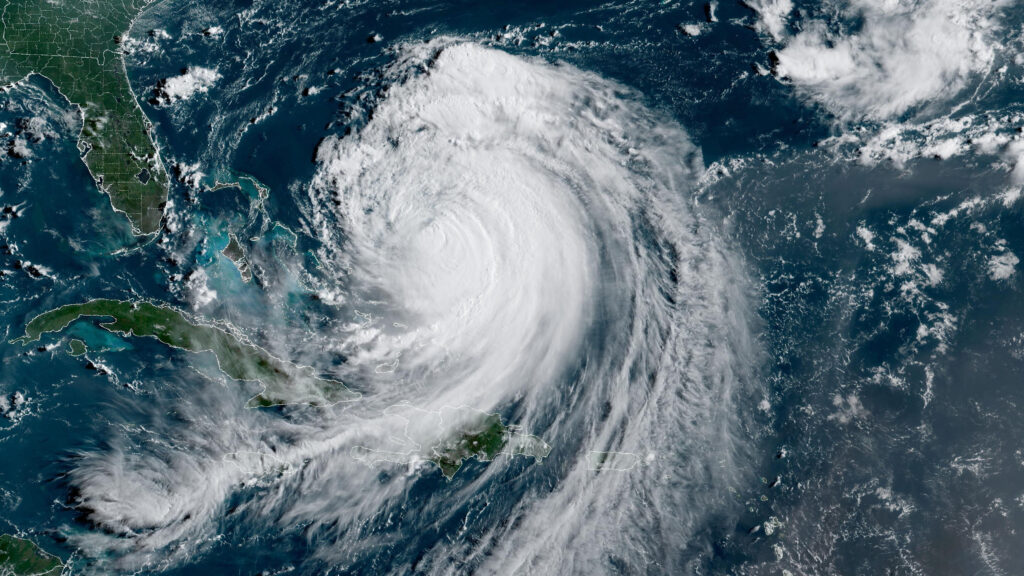
Hurricane Erin was expected to churn north parallel to the East Coast this week, bringing dangerous rip currents and coastal flooding threats even as forecasters said the storm was unlikely to make landfall in the United States.
The National Hurricane Center said Tuesday the storm, the first Atlantic hurricane of 2025, weakened to a Category 2 with maximum sustained winds of 105 mph. Erin’s center was about 650 miles southwest of Bermuda and roughly 690 miles south-southeast of Cape Hatteras, North Carolina, moving northwest at 9 mph.
Mandatory evacuations were ordered for Hatteras Island and Ocracoke Island in North Carolina’s Outer Banks, where forecasters warned of life-threatening storm surge and flooding later this week.
“It’s just not going to be a very safe environment to be in the ocean,” said Mike Brennan, the hurricane center’s director, who urged beachgoers along the East Coast to heed local warnings.
The storm was expected to turn north-northwest Tuesday, pass east of the Bahamas, and move between Bermuda and the U.S. East Coast Wednesday and Thursday, forecasters said. Erin remained a large system, with hurricane-force winds extending 80 miles from its center and tropical storm-force winds extending 205 miles.
Tropical storm warnings were issued for parts of the Outer Banks, Turks and Caicos, and the southeast Bahamas. Watches extended north into southern Virginia and across the central Bahamas.
Officials said Erin would continue to generate powerful rip currents and waves of 10 to 20 feet along much of the East Coast through the week. Beaches in New Jersey, New York, and Delaware have already restricted swimming.
“You’re allowed on the beach, but you will not be allowed in the water because we have treacherous conditions going on right now,” said Ed Schneider, beach patrol captain in Wildwood, New Jersey.
Erin briefly intensified to a Category 5 hurricane on Saturday before weakening. It is the fifth named storm of the 2025 Atlantic hurricane season, which NOAA has predicted will be above average with as many as 18 named storms, nine hurricanes, and up to five major hurricanes.
The season typically peaks between mid-August and mid-October.