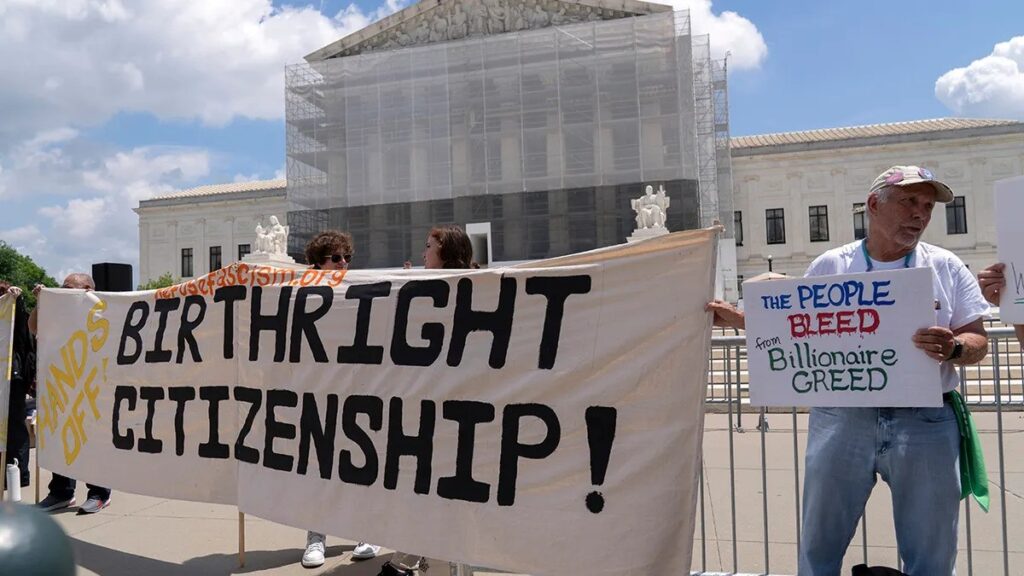
In what promises to be a historical ruling, the Supreme Court will take up the matter of birthright citizenship.
The SCOTUS agreed to decide the legality of Trump’s plan to roll back automatic birthright citizenship for those born in the United States. The original case stems from New Hampshire and is expected to be ruled upon by the end of June.
Trump, who has liberally used executive orders to achieve his objectives, has a 6-3 conservative majority and has thus far been a recipient of this advantage on several fronts.
“The Trump Administration looks forward to making its case on the issue of birthright citizenship on behalf of the American people,” Abigail Jackson, a White House spokeswoman said in a statement.
Birthright citizenship, a part of the 14th Amendment to the Constitution, has long been considered the standard requirement. The Amendment states: “All persons born or naturalized in the United States, and subject to the jurisdiction thereof, are citizens of the United States.”
The clause was to affirm that Black former slaves and their children were recognized as citizens.
But Trump is seeking to undo history as he continues to court immigration opponents as part of his immigration crackdown.
“For over 150 years, it has been the law and our national tradition that everyone born on U.S. soil is a citizen from birth,” Cecillia Wang, national legal director of the American Civil Liberties Union and one of the lawyers associated with the case, said in a statement. “We look forward to putting this issue to rest once and for all.”
Trump’s schema for birthright citizenship would be limited to people who are born to at least one parent who is a U.S. citizen or permanent legal resident. Children born to those who are legally visiting the country or those who enter illegally would not have the right of citizenship. Solicitor General D. John Sauer, who represents the administration, asserts that the meaning of the clause has been mistaken and that the executive order on the issue is to “restore the clause’s original meaning.”
“Yet, long after the Clause’s adoption, the mistaken view that birth on U.S. territory confers citizenship on anyone subject to the regulatory reach of U.S. law became pervasive, with destructive consequences,” Sauer wrote in court filings.
Lawyers for the ACLU, however, argue that the administration’s position is contrary to the Constitution, legal precedent, Congressional dictates, scholarly consensus, and over a century of “everyday practice.”
They point to an 1898 case, called United States v. Wong Kim Ark, in which the Supreme Court ruled that a man born in San Francisco to parents who were both from China was a U.S. citizen.
Announced on Trump’s first day in office, on Jan. 20, the policy has fared badly in lower courts, with judges across the nation ruling it unlawful, as they did in the New Hampshire case. As a result, the plan has not been implemented.
The Trump administration already secured Supreme Court intervention when it argued that individual judges did not have the authority to block the plan nationwide.