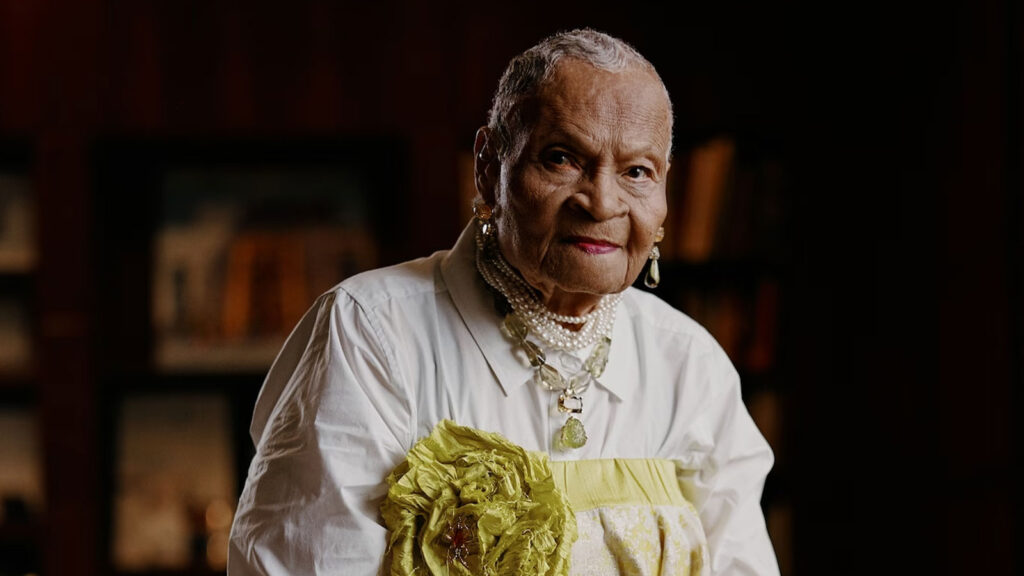
Viola Ford Fletcher, the oldest known survivor of the 1921 Tulsa Race Massacre and a lifelong advocate for justice for the victims of the attack, has died at 111, Tulsa Mayor Monroe Nichols announced Monday.
“Today, our city mourns the loss of Mother Viola Fletcher; a survivor of one of the darkest chapters in our city’s history,” Nichols said in a statement on social media. “Mother Fletcher endured more than anyone should, yet she spent her life lighting a path forward with purpose.”
Fletcher was seven years old when a white mob destroyed Tulsa’s Greenwood District, a thriving Black community known as “Black Wall Street,” after a Black teenager was accused of assaulting a white woman. Over the course of a day, rioters killed at least 300 Black residents, burned more than 35 city blocks and left thousands homeless. The National Guard declared martial law and detained roughly 6,000 Black residents, some for more than a week, according to the Tulsa Historical Society and Museum.
“We had friends and played outside and visited with neighbors and were happy there with our parents,” Fletcher told CBS News, recalling her childhood in Greenwood before the violence. “Just loved being there.”
Lessie Benningfield Randle, who turned 111 earlier this month, is now the last known survivor of the massacre. She, Fletcher and Fletcher’s brother, Hughes Van Ellis. who died in 2023, were plaintiffs in a 2020 lawsuit seeking reparations from the city and county. That suit is still moving through the courts.
Nichols called Fletcher a symbol of resilience and a driving force behind renewed efforts to address the long-lasting harm caused by the massacre.
“Mother Fletcher carried 111 years of truth, resilience, and grace and was a reminder of how far we’ve come and how far we must still go,” Nichols said. “She never stopped advocating for justice for the survivors and descendants of the 1921 Tulsa Race Massacre.”
Fletcher, a grandmother of six who lived in North Texas, frequently spoke about the trauma she carried for more than a century. In a 2021 interview, she said she thought about the massacre every day.
That same year, she testified before Congress: “I still see Black men being shot, Black bodies lying in the street. I still smell smoke and see fire. I still see Black businesses being burned. I still hear airplanes flying overhead. I hear the screams.”
No one was ever prosecuted for the attack, and Tulsa officials have long argued the city cannot be held financially responsible for events that happened more than 100 years ago. Survivors, descendants and civil rights advocates have continued to push for reparations, citing the ongoing economic and social damage.
A path toward compensation may be emerging. In June, Nichols unveiled a $105 million proposal for the first Tulsa Race Massacre Observance Day. The “Road to Repair” plan is aimed at addressing the lingering socioeconomic and health disparities tied to the massacre, according to The New York Times.
Fletcher’s funeral arrangements were not immediately announced.